Too Many Paths, No Destination: How Spiritual Abundance Is Keeping You Stuck
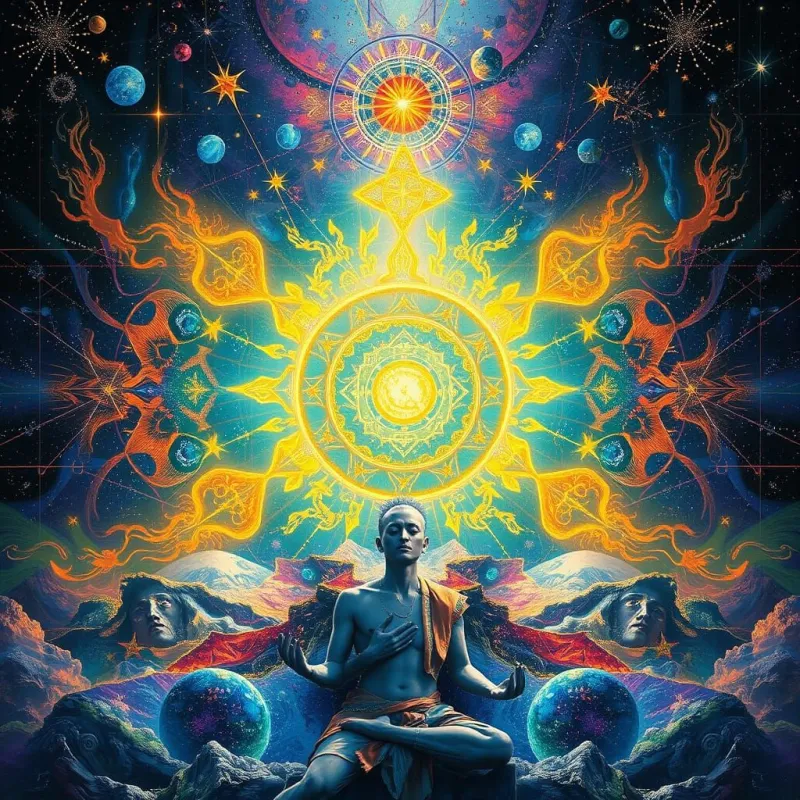
Photo: person meditating peacefully surrounded by many different spiritual objects overwhelmed, via images.nightcafe.studio
You Have Everything. So Why Does It Feel Like Nothing Is Working?
You've got a Headspace subscription you haven't opened in three weeks. There's a crystal collection on your nightstand next to a book on Stoicism, a deck of tarot cards, and a journal you started during your Ayurveda phase last spring. Your podcast queue is full of dharma talks, breathwork tutorials, and interviews with shamans. You've done the sound bath, the ecstatic dance, the cold plunge, and the silent retreat.
And yet — something still feels... off. Unfocused. Like you're always circling the thing rather than inhabiting it.
Welcome to one of the strangest paradoxes of modern spiritual life in America: the more options we have, the harder it becomes to actually go deep.
The Neuroscience Behind Your Spiritual Scatter
Psychologist Barry Schwartz famously coined the term "paradox of choice" to describe how an overabundance of options doesn't liberate us — it paralyzes us. His research showed that when people face too many decisions, they experience higher anxiety, lower satisfaction, and chronic second-guessing, even after they've made a choice.
This phenomenon doesn't stay in the cereal aisle. It follows you right onto the meditation cushion.
Neuroscientists have found that decision fatigue is a measurable cognitive state. Every time you choose — or reconsider — you're drawing on the same prefrontal cortex resources responsible for focus, willpower, and sustained attention. When those resources get depleted by constant spiritual comparison-shopping, there's simply less mental bandwidth left for the quiet, receptive state that genuine inner work requires.
In other words, the act of endlessly evaluating which practice to do is consuming the very energy you need to actually do the practice.
There's also something called "attentional residue" — a term coined by Georgetown professor Cal Newport. When you switch between tasks or commitments, a portion of your attention stays snagged on what you just left behind. Apply this to spiritual practice, and it means that even when you sit down to meditate, part of your mind is still wondering whether you should be doing yoga nidra instead, or whether that breathwork workshop next weekend might be the real key.
You're physically present on the cushion. But you're nowhere near arriving.
The Marketplace of Awakening
This isn't entirely your fault. The American wellness industry is now worth over $1.8 trillion, and it's built on the same attention-economy logic as social media: keep you browsing, keep you buying, keep you believing the next thing is the thing.
Spiritual content has been gamified. Apps reward streaks over depth. Influencers monetize modality-hopping. The algorithm serves you something new every time you begin to settle. What looks like a wealth of spiritual resources is, in many cases, a very sophisticated machine for keeping you in perpetual seeking mode — because a seeker who finds what they need stops consuming.
This isn't cynicism. It's just worth naming clearly: the culture around wellness is not always designed to help you integrate. Sometimes it's designed to keep you searching.
And searching, while it can feel productive, is not the same thing as transformation.
What Integration Actually Requires
Every major contemplative tradition — Zen Buddhism, Sufi mysticism, Christian contemplative practice, Indigenous ceremonial paths — shares one structural feature: commitment over time to a single, coherent framework.
This isn't coincidence. It reflects something true about how the human psyche actually changes.
Deep inner work requires what psychologists call "depth of processing." You can't get that from surface-level exposure to dozens of modalities. You get it from returning, again and again, to the same practice — watching how it shifts as you shift, noticing what it asks of you in different seasons of your life, learning its language from the inside out.
Think of it like learning a musical instrument versus dabbling in ten of them. You might pick up a few chords on a guitar, a couple of scales on a keyboard, a basic rhythm on a drum. But you won't play music — not really — until you commit to one and go all the way in.
The same is true for the inner life. Oneness isn't something you stumble into by trying everything. It's something you cultivate by going deep enough into one thing that the walls between you and it dissolve.
A Practical Framework for Choosing Your Path
So how do you actually choose? Here's a simple framework that prioritizes integration over novelty.
Start with resonance, not reputation. Forget what's trending on TikTok or what your most spiritually impressive friend swears by. Ask yourself: what practice, when I've done it consistently, has made me feel more like myself? More grounded, more open, more present? That's your signal.
Commit to a 90-day single-practice experiment. Pick one modality — just one — and agree to show up for it every day for 90 days. Not perfectly. Just consistently. This isn't forever; it's an experiment. But it's long enough to actually get past the beginner phase and into the territory where real integration starts to happen.
Create a "not right now" list. Write down every other practice or modality you're curious about. This isn't a rejection — it's a container. Knowing those options are held safely somewhere frees your nervous system from the constant background hum of "but what about...?"
Measure depth, not breadth. At the end of each week, instead of asking "did I try anything new?" ask "did I go anywhere new within my practice?" Did you notice something you hadn't before? Did the practice ask something different of you? Depth is the metric that matters.
Find a community or teacher. One of the most reliable ways to stay committed to a single path is to be in relationship with others who walk it too. Whether that's a local meditation group, an online sangha, or a one-on-one teacher, accountability and shared context dramatically increase the likelihood that you'll stay long enough to actually arrive somewhere.
The Quiet Revolution of Enough
There's something quietly radical about deciding that you have enough — enough practices, enough teachers, enough apps — and that what you actually need now is less, not more.
In a culture that profits from your spiritual restlessness, choosing depth over breadth is a genuinely countercultural act. It's also, according to both contemplative wisdom and modern neuroscience, the only path that actually leads to the unified inner life you're looking for.
The fragmentation you feel isn't a sign that you haven't found the right practice yet. It's a sign that you've been practicing the seeking itself.
You already have what you need. The only question is whether you're willing to go all the way in.
That's where oneness lives — not in the next app, the next retreat, the next modality. But in the quiet, consistent, unglamorous act of returning to the same place until it becomes home.
